Expansion of Trade
In a largely rural agricultural area, Thame market played a key role in the town. In 1722, novelist Daniel Defoe described it as ‘a great corn market’, and in 1746 said it was ‘well furnished with live cattle and all other provisions and necessaries’. The Georgian houses in the High Street indicate the prosperity of the upper-class townsman in the early 1700s.
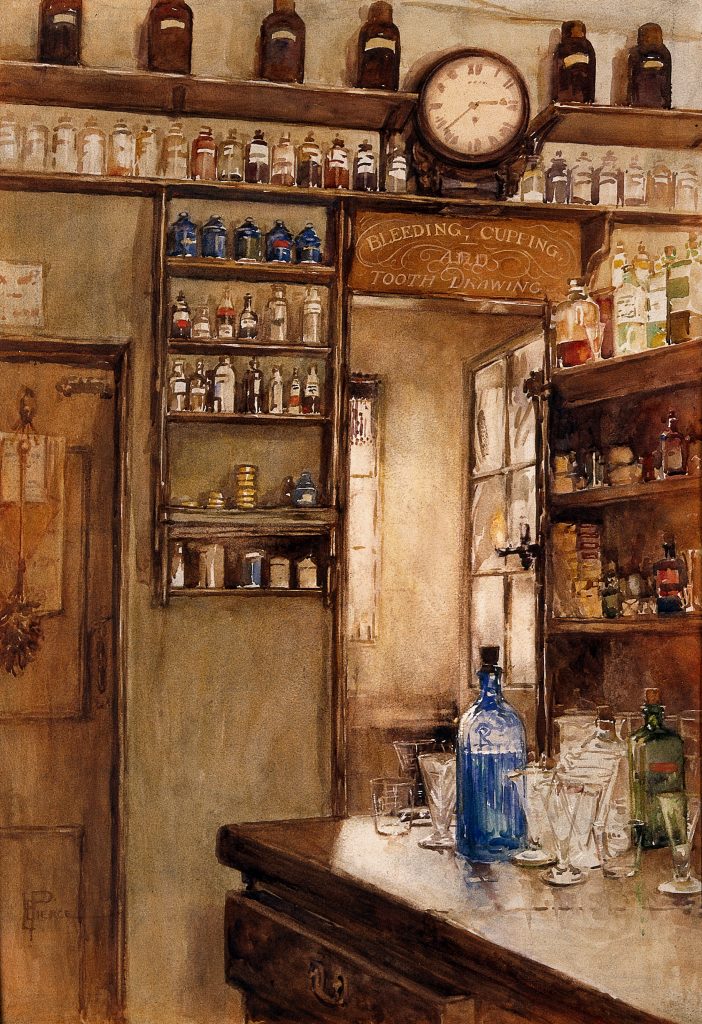
New trades developed during the Georgian era including attorneys, apothecaries, clockmakers, saddlers and whipmakers. However, the craftsmen and shopkeepers of Thame were dependent on the prosperity of the surrounding agricultural area. After the Napoleonic Wars had ended, Thame experienced a depression from 1815 to 1818.
An apothecary’s shop: interior. Watercolour by Lucy Pierce. Attribution-NonCommercial 4.0 International (CC BY-NC 4.0). Source: Wellcome Collection.

Georgian buildings along Corn Market (although some of them are older buildings with brick-built Georgian fronts).

Long case 30-hour clock. Richard Stone, Thame, 1770s. Long case clocks were developed in the late 1600s and kept much better time. By the 1700s, they were popular not only in London but also in the provinces. Richard Stone, who lived at the Spread Eagle, was apprenticed in 1761 to a clock-maker in London but returned to Thame to work as a clock and watchmaker.
See this clock in the main gallery
